



The choice between home care and a care home is deeply personal.
The choice between home care and a care home is deeply personal. It's one that families across North East Derbyshire face every day — often during a difficult time, when emotions are running high and decisions feel overwhelming. There's no single right answer, but there is a right answer for your family, and understanding the options clearly can help you find it.
Whether you're looking into care for a parent in Chesterfield, a grandparent in Bolsover, or a loved one living independently in Mansfield or Worksop, this guide aims to lay out the honest picture — the benefits, the challenges, and the practical things worth considering.
What Do We Mean by Home Care and Residential Care?
Home care (sometimes called domiciliary care) means a professional carer visits your loved one in their own home. Visits might be as short as 30 minutes or as long as a full day, depending on what's needed. Some people have a single daily visit for help with medication; others receive several visits throughout the day and night for more complex needs.
Residential care means moving into a care home, where staff are available around the clock. Some homes offer nursing care for those with medical needs, while others focus on personal care and daily living support.
Both options exist on a spectrum. It's not always one or the other — and what works now may change as needs evolve.
The Case for Staying at Home
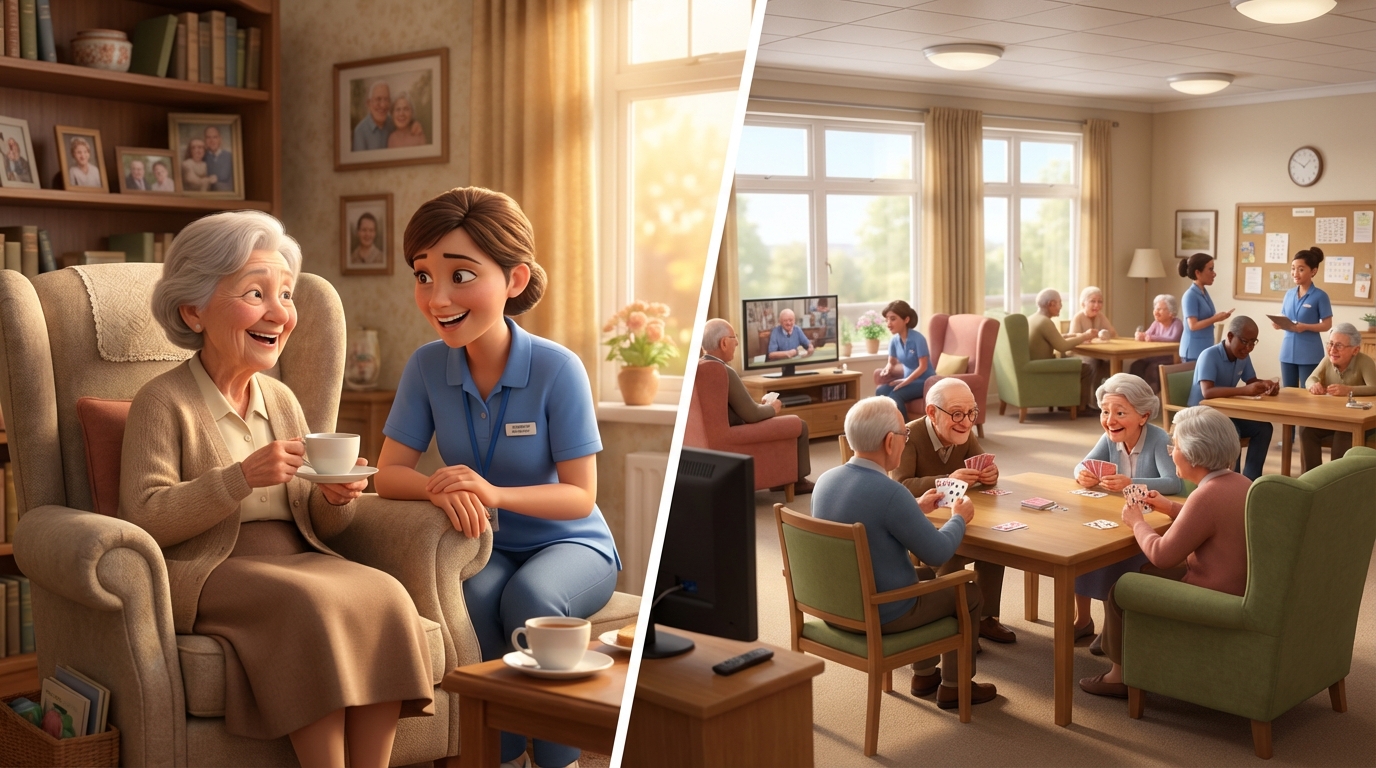
For many people, home is far more than four walls. It's where the kettle is in the right place, the garden is full of familiar plants, and the neighbours know your name. There's a deep comfort in that — and research consistently shows that older people who remain in familiar surroundings tend to feel happier, more confident, and more in control of their lives.
Home care allows your loved one to:
- Stay in their own community, close to friends, family, and local routines
- Keep their pets — something that matters enormously to many people
- Receive one-to-one attention from a dedicated carer, rather than sharing staff with dozens of other residents
- Maintain independence, making their own choices about meals, routines, and how they spend their day
- Receive exactly the level of support they need — no more, no less
For families in areas like Chesterfield, Bolsover, and the surrounding villages, home care also means your loved one stays connected to the community they've known for years. They can still pop to the local shop, attend their usual GP surgery, or have a neighbour round for a cup of tea.
When Residential Care Might Be the Better Fit
It's important to be honest: home care isn't always the right solution. There are situations where a care home genuinely offers a better quality of life.
Residential care may be more suitable when:
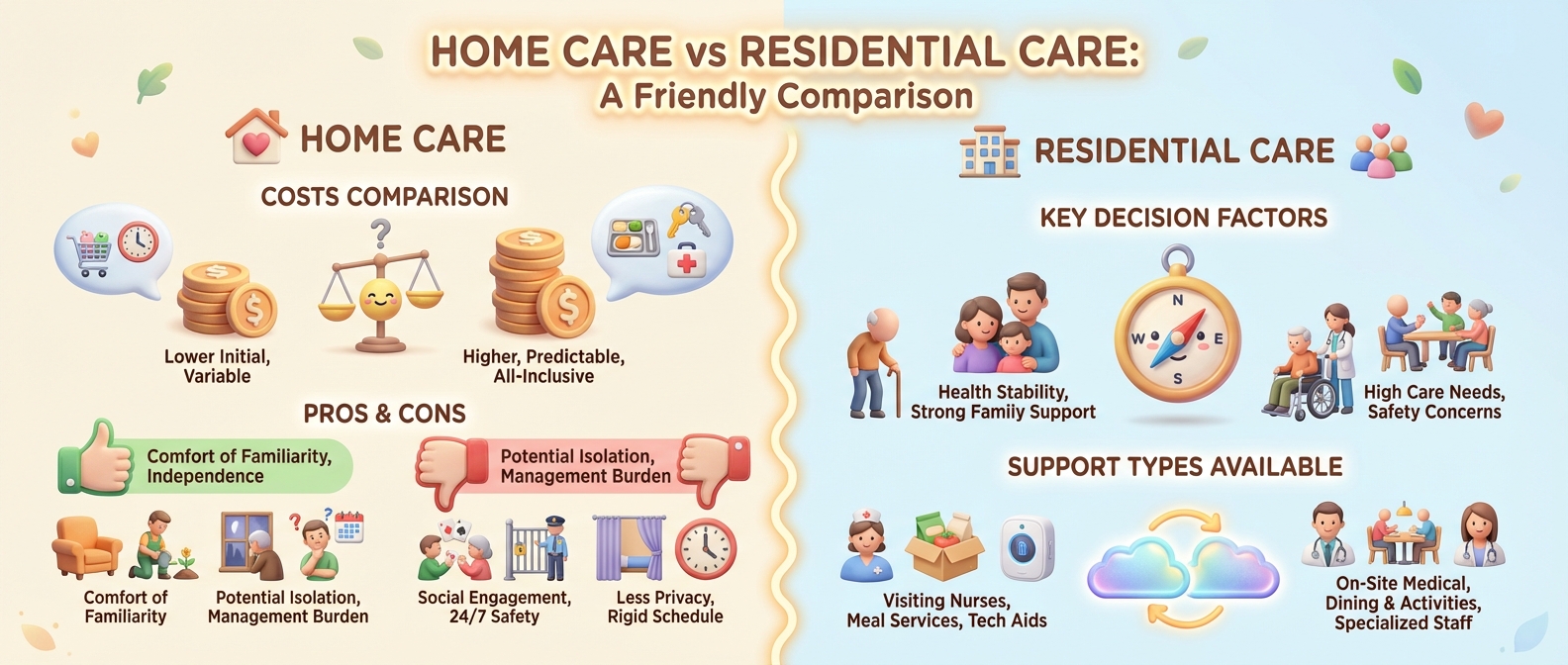
- Your loved one has advanced dementia and needs constant supervision for their safety
- They feel isolated at home and would benefit from the social environment a care home provides
- Their care needs are so extensive that round-the-clock home care would be impractical or prohibitively expensive
- The home environment itself presents risks — steep stairs, poor heating, or a layout that can't be adapted
- Family carers are exhausted and a sustainable long-term plan is needed
A good care home can offer wonderful companionship, structured activities, and peace of mind for the whole family. There's no shame in choosing that path — sometimes it's the most loving decision you can make.
Understanding the Costs
Cost is often the elephant in the room, so let's address it plainly.
In the UK, the average cost of a residential care home is roughly £800 to £1,200 per week, depending on the area and the level of care. Nursing homes typically cost more. In Derbyshire, you might find costs sitting at the lower to middle end of the national range, but it's still a significant commitment.
Home care is charged by the hour, typically between £20 and £30 per hour in our part of the country. For someone needing two or three visits a day, weekly costs might range from £300 to £700. For those requiring live-in care, costs can be comparable to residential care — though you're paying for one-to-one attention in your own home.
The key difference is flexibility. With home care, you only pay for the support you actually need. If your loved one has a good week and manages well with fewer visits, costs come down. That's simply not the case with a fixed residential fee.
It's also worth knowing that your local authority — Derbyshire County Council, Nottinghamshire County Council, or your relevant borough — may contribute to costs following a needs assessment. Attendance Allowance is another benefit many families overlook, and it's not means-tested.
Questions Worth Asking Yourself
When you're weighing up the options, it can help to sit down — perhaps with a cup of tea and a family member — and work through some honest questions:
- What does your loved one actually want? Their voice matters most. Many people assume their parent wants to move into a home, when in reality they're desperate to stay put.
- What are the specific care needs right now? And how might they change over the next year or two?
- Is the home environment safe? Simple adaptations — grab rails, a key safe, better lighting — can make a huge difference.
- Who else is involved in care? If family members are providing informal care, are they coping? Are they burning out?
- What would bring the most comfort and dignity? Not the most convenient option, but the one that honours your loved one's wishes and personality.
A Third Option: Starting with Home Care
Something we see regularly with families across North East Derbyshire is a phased approach. Rather than making one big, irreversible decision, many people start with home care — perhaps a daily visit to help with getting up, washing, and breakfast — and see how things go.
This gives everyone time to adjust. Your loved one gets to stay in familiar surroundings while receiving professional support. You get to see how they respond, how their needs develop, and whether home care continues to be the right fit. If things change, the move to residential care can be made with confidence rather than panic.
It's not a compromise — it's a sensible, compassionate way to navigate a difficult transition.
You Don't Have to Figure This Out Alone
If you're at the beginning of this journey — or somewhere in the middle, feeling unsure — please know that it's perfectly normal to feel uncertain. These are big decisions, and there's no instruction manual.
We're always happy to have an honest conversation about whether home care might be right for your family. We cover Chesterfield, Bolsover, Worksop, Mansfield, and the surrounding areas across North East Derbyshire, and we've helped many families think through exactly these questions — with no obligation and no pressure.
You can call us, drop us a message, or simply ask us to pop round for a chat. Sometimes, just talking it through with someone who understands care makes the whole thing feel a little less daunting.


