



When the Prime Minister stood alongside Andy Burnham at the end of July to promise a new path for social care, it was easy for families up and down the country — including right here in Chesterfield — to feel a flicker of scepticism. Social care has had more reviews and promises than most of us care to count. But the plan taking shape, an NHS-style National Care Service with national standards and a route away from the current patchwork of council-by-council eligibility, is a genuinely different kind of ambition from what's come before. For families across North East Derbyshire, the detail that matters isn't the Westminster rhetoric but the practical questions: will eligibility criteria become more consistent between Derbyshire County Council and its neighbours, will funding actually follow need, and how quickly any of this reaches a kitchen table in Bolsover or Worksop rather than staying a Whitehall slide. Reform of this scale, if it happens at all, is likely to be measured in years rather than months — which is exactly why it's worth watching closely rather than waiting for it to change anything this winter. Whatever shape national reform eventually takes, what won't change is the day-to-day reality of good home care: a carer who turns up on time, knows your mum's routine, and treats her with dignity. We'll keep tracking this story as it develops and translate what it actually means for local families, rather than just repeating the headlines.

What Is the National Care Service, Exactly?
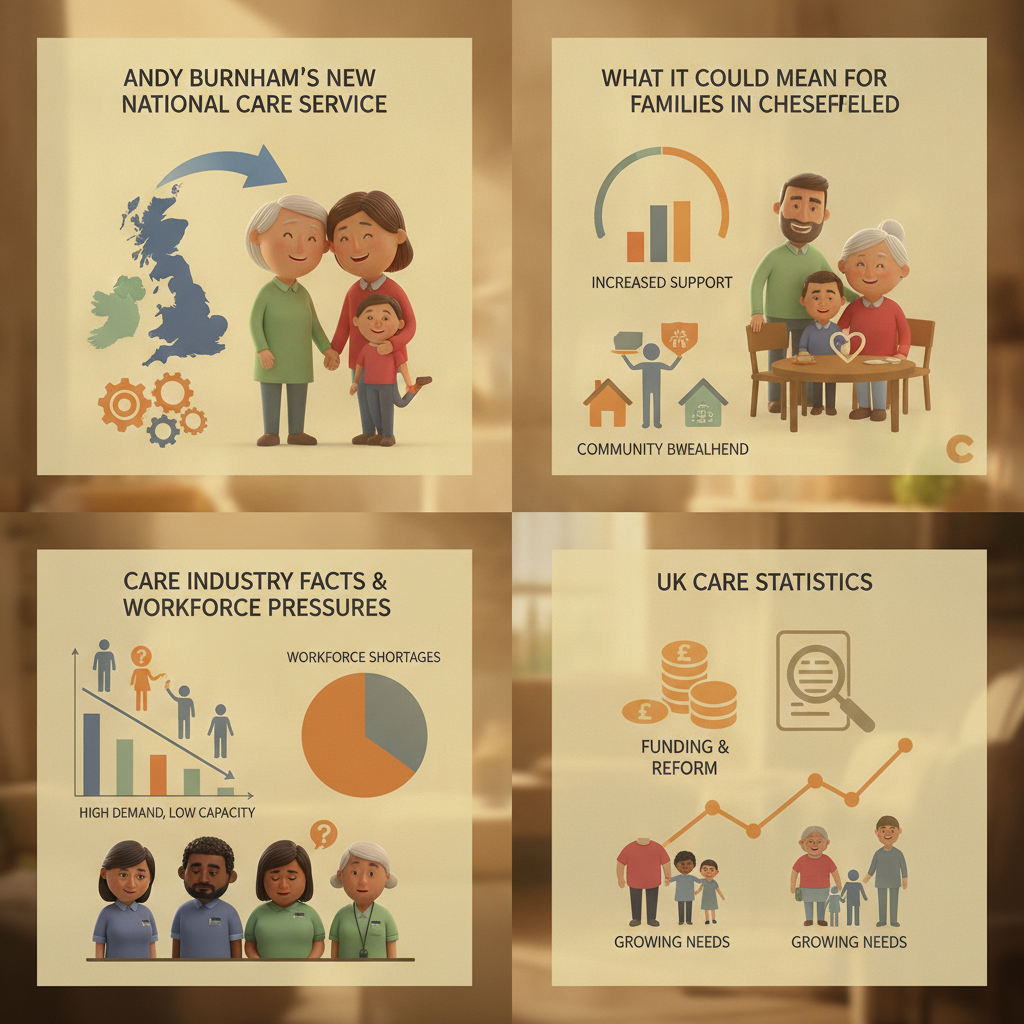
When the Prime Minister stood alongside Andy Burnham at the end of July to promise a new path for social care, it was easy for families up and down the country — including right here in Chesterfield — to feel a flicker of scepticism. Social care has had more reviews and promises than most of us care to count. But the plan taking shape, an NHS-style National Care Service with national standards and a route away from the current patchwork of council-by-council eligibility, is a genuinely different kind of ambition from what's come before.
For families across North East Derbyshire, the detail that matters isn't the Westminster rhetoric but the practical questions: will eligibility criteria become more consistent between Derbyshire County Council and its neighbours, will funding actually follow need, and how quickly any of this reaches a kitchen table in Bolsover or Worksop rather than staying a Whitehall slide. Reform of this scale, if it happens at all, is likely to be measured in years rather than months — which is exactly why it's worth watching closely rather than waiting for it to change anything this winter.
Whatever shape national reform eventually takes, what won't change is the day-to-day reality of good home care: a carer who turns up on time, knows your mum's routine, and treats her with dignity. We'll keep tracking this story as it develops and translate what it actually means for local families, rather than just repeating the headlines.

Why This Proposal Is Different
Social care reform has a long and slightly embarrassing history of promises that quietly disappeared. The Dilnot Commission's recommendations on capping care costs, first published back in 2011, took over a decade to even partially surface in legislation, and large parts were later shelved again on cost grounds. Families who've lived through a parent's care journey over the past fifteen years have learned, understandably, to treat any new announcement with caution.
What makes the Burnham proposal worth a second look is the scale of what's being discussed: a genuinely national system with consistent standards, rather than another tweak to the existing council-led model. At the moment, whether you qualify for council-funded care, and how much you're expected to contribute, depends heavily on which local authority you live under. A National Care Service, in its fullest form, would aim to iron out some of that postcode-lottery effect — so that an assessment of need in Chesterfield carries roughly the same weight, and leads to roughly the same support, as one in a neighbouring authority in Nottinghamshire.
That's the theory. Delivering it means resolving thorny questions about funding, workforce pay, and the relationship between the NHS and social care that have defeated several governments before this one. Worth watching, then — but worth watching with your feet firmly on the ground.
What It Could Mean for Derbyshire Families
If national standards do eventually bed in, the most noticeable change for local families is likely to be around consistency. At present, Derbyshire County Council runs its own eligibility assessments, and support can look different again just over the border. A family in Bolsover arranging care for an elderly parent, or a household in Worksop coordinating support across the Nottinghamshire boundary, can end up navigating two different sets of rules despite living only a few miles apart.
A genuinely national framework would, in principle, smooth that out — making it easier to understand what you're entitled to regardless of exactly where the boundary line falls. It could also mean clearer routes between NHS-funded support (such as reablement care after a hospital stay) and longer-term social care, which is one of the most common sources of confusion and delay for families right now. Anyone who's tried to work out whether a loved one's care should be funded by the NHS, the council, or privately, knows how much time and stress sits in that grey area.
None of this is likely to change anything in the next few months, and it would be doing local families a disservice to suggest otherwise. But it's a direction worth keeping an eye on, particularly if you're starting to think ahead about a parent's or partner's future care needs.
What You Can Do Now, Regardless of Reform
The most useful thing we can offer families while all of this works its way through Parliament is a reminder that you don't need to wait for national reform to get good, well-organised support in place. A few practical steps make a real difference:
Get a needs assessment sooner rather than later. Derbyshire County Council carries out care needs assessments regardless of whether you end up self-funding or receiving council support, and having one on record gives you a clearer picture of what's available, and a paper trail if circumstances change later.
Understand the difference between NHS and council-funded support. If a loved one has recently been in hospital, ask specifically about NHS Continuing Healthcare and reablement support before assuming the costs will fall to the family. It's one of the areas where good domiciliary care providers can help you ask the right questions.
Start conversations early. Whether it's about finances, preferences for staying at home versus residential care, or simply what a typical day should look like, these conversations are far easier to have calmly in advance than during a crisis.
Keep a record of changing needs. Small changes — a bit more help needed with medication, a bit less confidence on the stairs — are easy to miss day to day but matter a great deal when it comes to reassessing care packages, whatever system eventually governs them.
Where Home Care Fits Into the Bigger Picture
One thing that tends to get lost in national policy debates is that most people, given the choice, want to stay in their own home for as long as possible. National reform is mostly concerned with funding structures and eligibility criteria — important things, but one step removed from the daily reality of care. Domiciliary care exists precisely because staying at home, surrounded by familiar things, a known routine, and often a much-loved pet, matters enormously to wellbeing, independence, and dignity.
Whatever the National Care Service eventually looks like — if it arrives in anything like its current form — the practical experience of care at home will still come down to the same fundamentals: a consistent, well-trained carer who shows up when they say they will, communicates properly with family, and treats the person they're supporting as an individual rather than a task on a list. That's as true for a family in Chesterfield as it is for one in Mansfield or anywhere else across North East Derbyshire.
It's also worth saying that good local providers are often better placed than any national system to respond quickly to a change in need — a short-term increase in visits after a fall, extra support following a hospital discharge, or simply a change in personality preference between carer and client. National standards can set a floor; they can't replace the relationship between a family and the people actually walking through the front door.
We'll Keep Watching This Space
The National Care Service is, at the time of writing, still a plan rather than a reality — and a great deal will depend on funding decisions, legislative timetables, and the inevitable twists of Westminster politics over the coming years. We don't think it's helpful to either dismiss it out of hand or promise families changes that may be a long way off.
What we can promise is that we'll keep following the story, and we'll keep explaining what it actually means in practical terms for families here in Chesterfield, Bolsover, Worksop, and across North East Derbyshire — not just repeating the press releases.
In the meantime, if you're starting to think about care for a parent, partner, or loved one, and would simply like an honest conversation about what good home care looks like and how it might fit your family's situation, we're always happy to talk things through — no pressure, no obligation, just a chat about what matters most to you.


