



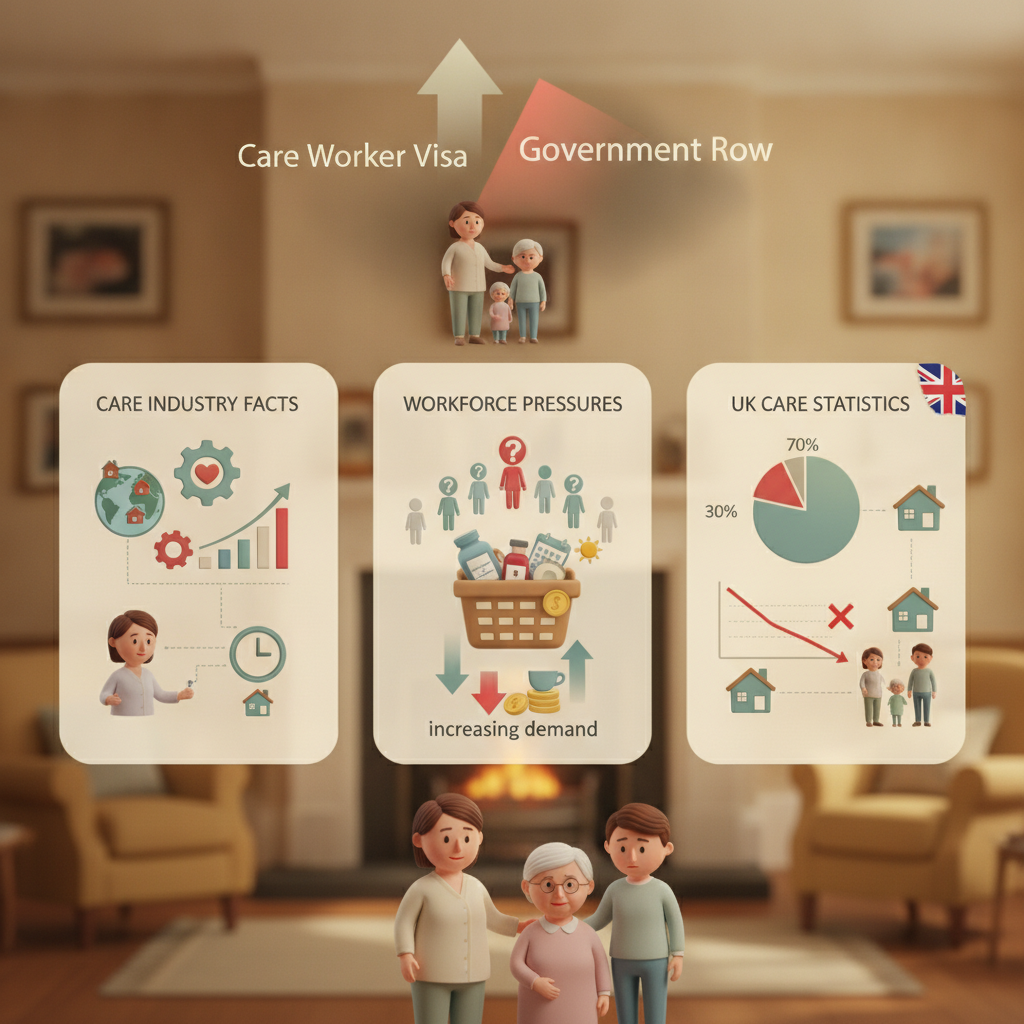
If you have seen the headlines this week about care worker visas, you may be wondering what it means for your family and the carers who visit your home. Angela Rayner has publicly challenged plans to change immigration rules retrospectively for overseas care workers already living and working in the UK — and the care sector is watching very closely. The concern is that shifting the rules mid-way through a worker's visa creates uncertainty for dedicated carers who made life decisions based on those original terms. Here in North East Derbyshire, Chesterfield, and Bolsover, home care providers — including us — rely on a committed, mixed workforce of local and internationally recruited staff. We want to reassure families that we are monitoring developments and that continuity of care for our clients remains our absolute priority.

What Is the Row Actually About?
To understand the debate, it helps to know a little background. In recent years, the care sector across England — and particularly in areas like Chesterfield, Bolsover, Worksop, and Mansfield — has faced serious recruitment challenges. The number of local people willing and able to work in domiciliary care has not kept pace with the growing demand for home support. To address this, the government introduced the Health and Care Worker visa, which allowed registered providers holding a sponsor licence to recruit internationally.
Thousands of workers from countries including India, Zimbabwe, Nigeria, and the Philippines moved to the UK on these visas to work as care assistants and support workers. Many brought family members with them, settled into communities, and built lives here — some in our own area of North East Derbyshire. These are not abstract policy statistics; they are real people visiting elderly residents in their homes, helping with personal care, preparing meals, providing companionship, and in many cases becoming a trusted presence in someone's week.
The current controversy centres on proposals to change the rules for workers who are already here — not for new applicants, but for people who arrived under terms they understood and relied upon. Angela Rayner has spoken out against this approach, arguing that it is fundamentally unfair to shift the goalposts for people who made significant life decisions based on the original conditions of their visa. That view is widely shared across the social care sector, including by national bodies such as Skills for Care and the Homecare Association.

Why the Care Sector Is Paying Such Close Attention
Home care providers operate on very tight margins, with staffing being by far their largest cost and challenge. Recruiting and retaining good carers is something every provider in North East Derbyshire thinks about constantly. Our workforce is genuinely mixed: many of our colleagues were born and raised locally — in Chesterfield, Clay Cross, Dronfield, and the surrounding villages — while others came from overseas specifically to work in care. Both groups are equally valued, and both matter enormously to the families we support.
When visa uncertainty arises — even before any final decision has been made — it creates real anxiety for workers weighing up whether to stay or whether to seek employment elsewhere. In some cases, carers have begun exploring options in other sectors, such as the NHS, where visa conditions differ. Losing experienced, compassionate carers to uncertainty is not a hypothetical risk. It is something providers across our region are managing right now, and it ultimately affects the families relying on consistent domiciliary care at home.
It is also worth remembering who these workers support: older adults living alone, people with complex health conditions, individuals recovering from hospital stays, and those living with dementia who depend on familiar, trusted faces. Disruption to their care is not a theoretical concern. It has a very direct impact on wellbeing, dignity, and independence — and that is something every responsible provider takes seriously.
What This Means for Families Using Home Care Right Now
We want to be straightforward with you: the situation is still developing, and no final policy decision has been confirmed. What we can tell you clearly is what we are doing and what questions are worth asking of your own care provider.
For families currently receiving home care in Chesterfield, Bolsover, North East Derbyshire, and surrounding areas, the most important thing right now is open communication with your provider. A responsible care company should be keeping you informed about any changes to your care team and should have contingency plans in place. If you have not heard anything, it is entirely reasonable to ask.
The consistency of the same carer — the same person who knows how you take your tea, who understands your morning routine, who you trust to help with something as personal as washing and dressing — matters enormously, particularly for older adults or people living with dementia. Disruption to that consistency is something good providers work hard to avoid.
Here are some practical steps you can take if you are concerned:
- Contact your care provider directly and ask how the visa situation is affecting their workforce and what their contingency arrangements are.
- Make sure your care plan is current — if your needs have changed recently, an updated plan makes it easier for any new carer to support you well from the outset.
- Speak to your GP or local authority social care team if you have concerns about a potential gap in your support.
- Keep your emergency contacts up to date with your care provider so the right people can be reached quickly if anything changes at short notice.
Our Commitment to You
Here at The Right Home Care Team, we recruit locally wherever we can, and we invest in training and development to support our staff and encourage them to stay with us for the long term. We have always been thoughtful about how we build our workforce, and we do not rely on a single recruitment pipeline. That diversity provides us with some resilience when challenges arise in any one area.
We are members of regional and national care networks, which means we receive early guidance when policy changes are confirmed, and we act on that guidance promptly. We are also in regular contact with Skills for Care and follow sector guidance from the Homecare Association on workforce planning and best practice.
What we can promise above all else is transparency. If there are changes that could affect your care or a family member's care, you will hear from us directly — not from a news headline.
The Bigger Picture We Cannot Ignore
The care worker visa debate is really part of a much larger question about how the UK values and funds social care. The sector became reliant on international recruitment precisely because domestic pay and conditions have never been sufficient to attract enough people locally. Changing visa rules without addressing underlying funding, pay, and career progression does not solve that problem — it simply shifts it.
If this issue matters to you — and we suspect it does, given that you are reading this — it is worth contacting your local MP and making your voice heard. The more visible the real-world impact on families in places like Chesterfield, Worksop, Bolsover, and Mansfield, the harder it is for policymakers to treat the social care workforce crisis as an afterthought.
We Are Here If You Have Questions
If you would like to talk through how this situation might affect your care, or if you are considering home care for the first time and want to understand how we manage our workforce, please do not hesitate to get in touch. You can call our team or send us a message through our website, and we will give you an honest, straightforward answer — no jargon, no corporate waffle.
We are here, we are watching this closely, and the care of every person we support in North East Derbyshire matters to us deeply — not just as a professional commitment, but as a personal one.


