



CQC has changed how it assesses services. Here's what it means.
CQC has changed how it assesses services. Here's what it means.
If you've been following news about adult social care over the last couple of years, you'll have heard about the Care Quality Commission's new way of inspecting services. The single assessment framework replaces the older system of separate inspections for different types of provider, and it's now shaping how every domiciliary care agency in North East Derbyshire — and across the country — is being judged. For families using care at home, it matters more than you might think.
What's actually changed?
Until fairly recently, CQC ran scheduled inspections, produced a long report, and gave a rating. The new framework keeps the familiar four ratings — Outstanding, Good, Requires Improvement, and Inadequate — but the way evidence is gathered has shifted. Instead of one big inspection every couple of years, CQC now collects information continuously. They look at feedback from people receiving care, relatives, staff, and partner organisations, alongside the data services share with them.
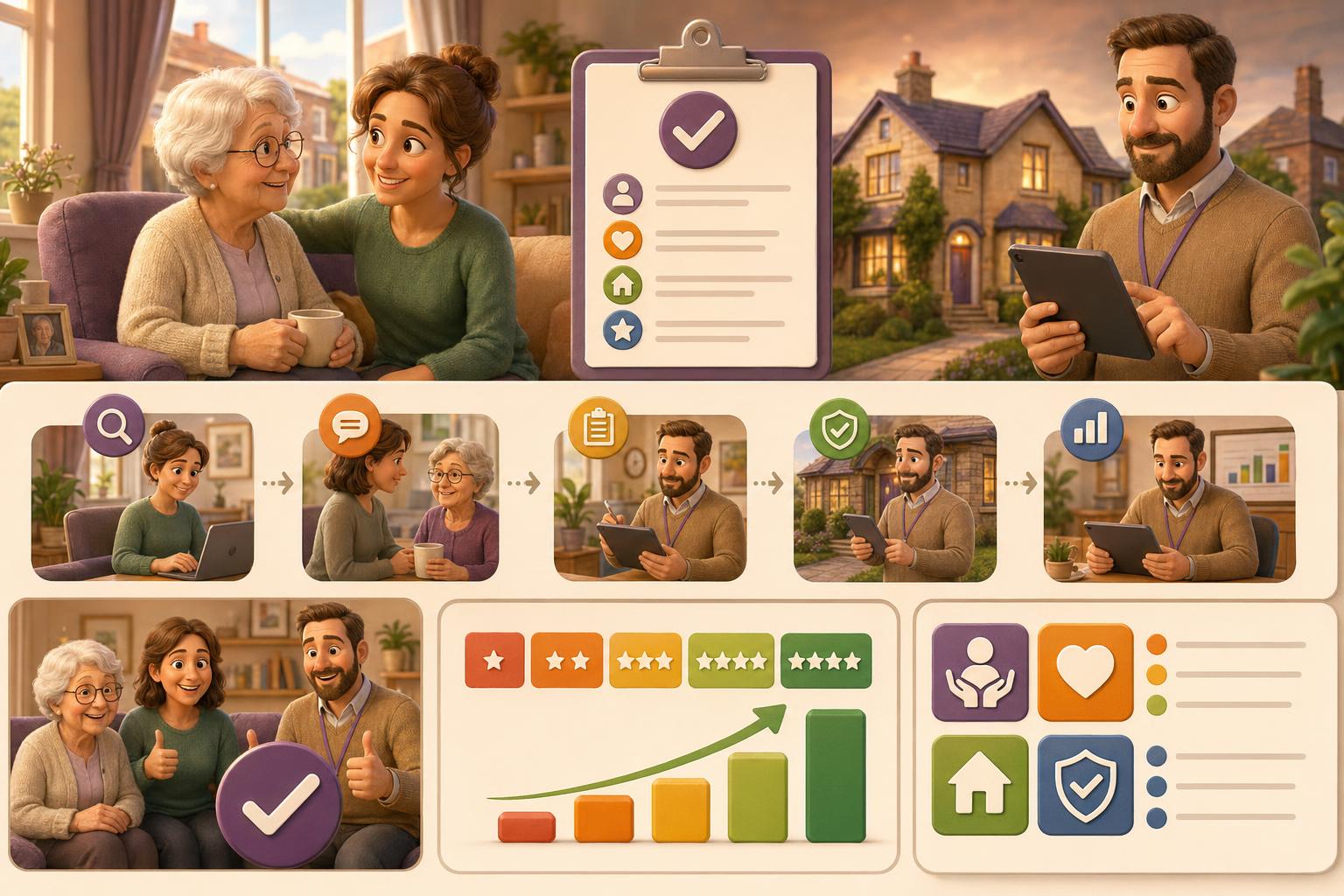
The framework is built around five familiar key questions: is the service safe, effective, caring, responsive, and well-led? Underneath those sit 34 "quality statements" — short, plain-English descriptions of what good care looks like. Things like "people are treated with kindness, empathy and compassion" or "leaders have the skills, knowledge, experience and credibility to lead effectively". Each one is scored, and the scores roll up into the overall rating.

Why the change matters for families
The biggest practical difference is that ratings can now move up or down between formal inspections. If concerns are raised — or if a service is doing exceptional work — CQC can update the rating without waiting for the next visit. For families choosing a provider in Chesterfield, Bolsover, or further afield in Mansfield and Worksop, that means the information on the CQC website is more current than it used to be.
It also means your voice carries more weight. CQC actively invites feedback through its Give Feedback on Care service, and that feedback feeds directly into the evidence base. If your mum's carers are wonderful, telling CQC helps protect that quality. If something isn't right, raising it early can prompt action long before a scheduled inspection.
What good domiciliary care looks like under the new framework
The new quality statements give a useful checklist when you're weighing up providers. A few of the things CQC now looks for closely:
Person-centred care that's actually personalised. Generic care plans don't pass muster anymore. Inspectors want to see that a service knows the person — their history, preferences, what makes a good day, what a bad day looks like — and adapts accordingly.
Continuity of carers. Rotating a different face through the door every visit isn't considered good practice. Services are expected to organise their rotas so the same small team supports each person wherever possible. For someone living with dementia in a village outside Chesterfield, that continuity isn't a luxury — it's essential.
Honest, learning culture. When something goes wrong, what happens next? CQC wants to see services that own mistakes, tell families openly, and change practice as a result. Defensiveness is now a red flag.
Staff who feel supported. The well-led question looks closely at how carers are treated. Fair pay, proper training, supervision, time between calls — these all show up in the inspection. Burned-out carers can't deliver kind care, and inspectors know it.
How to use CQC reports when choosing care
If you're starting to look at home care for a relative, the CQC website is a sensible first stop, but reports are most useful when you read them carefully rather than just glancing at the overall rating. A few tips:
Look at the date of the most recent assessment activity, not just the last full inspection. Under the new framework you may see a recent update without a full report attached.
Read the "responsive" and "caring" sections closely. These tend to capture the lived experience of people using the service, which is what matters day to day.
Notice what's said about leadership. A well-led service tends to be a stable one, and stability matters when you're inviting carers into your loved one's home several times a day.
Cross-reference with local knowledge. Talk to the GP surgery, the district nurses, neighbours who've used care. In communities like ours across North East Derbyshire, word travels — and it's often the truest signal of all.
What providers should be doing
For domiciliary agencies, the new framework rewards services that have always taken quality seriously and exposes those that coasted between inspections. The shift towards continuous evidence means you can't tidy up for inspection day — the culture has to be right all the time.
Good providers are now spending more time gathering structured feedback from the people they support and their families, auditing care plans regularly, and being transparent when things slip. They're also paying close attention to staff wellbeing, because the link between how carers are treated and the quality of care delivered has never been clearer in CQC's eyes.
What this means in practice for you
If your relative already receives care, you don't need to do anything differently — but it's worth knowing that your feedback genuinely shapes how a service is rated. Speak up, both when things are going well and when they're not. Most providers welcome this; the ones that don't are telling you something important.
If you're at the start of the journey and looking at options around Chesterfield, Bolsover, Worksop, or Mansfield, take your time. Read the reports, visit the office if you can, ask how carers are recruited and trained, and ask specifically about continuity. A good provider will answer those questions warmly and in detail.
A final thought
Regulation can feel distant and bureaucratic, but the new framework is genuinely trying to put the experience of people receiving care at the centre of how services are judged. That's a welcome shift. It means the quiet, consistent, kind work that good carers do every day — the cup of tea remembered just right, the gentle conversation while medication is sorted, the call home to a worried daughter — is being recognised as the heart of what makes care safe and effective.
If you'd like to talk through what care at home might look like for someone you love, we're always happy to have a no-pressure chat. Whether you're just starting to think about support or weighing up a change of provider, getting good information early makes everything that follows a little easier.


